
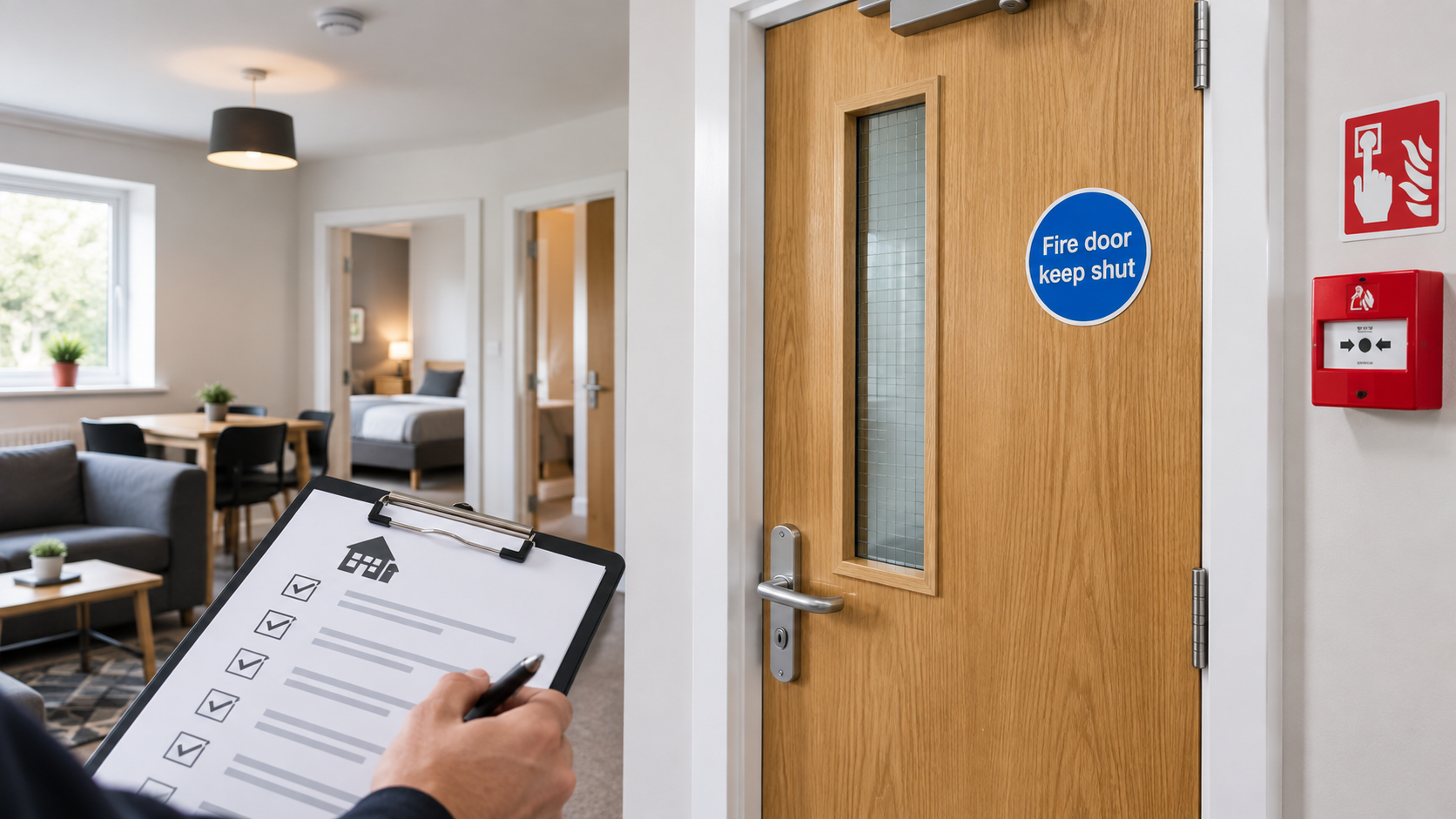
If you own or manage an HMO, a block of flats, or any rental property with shared communal space, fire door compliance is not optional. It is the law. And it is one of the fastest ways to lose your HMO licence or end up with an enforcement notice if you get it wrong.
A lot of landlords still think fire safety law only applies to offices and shops. It does not. If your property has a shared hallway, a staircase, or a communal kitchen, you are almost certainly covered by fire safety legislation right now, whether your council has mentioned it or not.
This guide breaks down what the law actually requires, where FD30 fire doors fit in, and what you need to do to stay compliant across your rental properties.
Table of Contents
ToggleWho Counts as the Responsible Person
Under the Regulatory Reform (Fire Safety) Order 2005, someone has to be named as the “Responsible Person” for every building that falls under the Order. That includes the common parts of HMOs and blocks of flats.
The definition is broad. It covers landlords, managing agents, freeholders, and anyone else with a degree of control over the building. If that is you, the law expects you to carry out a fire risk assessment, identify the hazards, and put measures in place to reduce the risk. Fire doors are one of the biggest parts of that picture.
Here is the part that catches people out. Even a small three bedroom house let to sharers has a hallway and a staircase. That is enough to bring the whole property within scope of the Order. Size does not exempt you.
What the Fire Safety Act 2021 Changed
For years there was genuine confusion about whether flat entrance doors counted as part of a building’s fire safety obligations. The Fire Safety Act 2021 settled that argument for good.
It confirmed that the Fire Safety Order applies to a building’s structure, its external walls, and the individual flat entrance doors between each flat and the shared common parts. If you manage a converted property or a block of flats, that means every flat entrance door now sits firmly inside your fire risk assessment. You cannot treat it as the tenant’s problem.
The Fire Safety Regulations 2022 added more detail on top of this. For buildings over 11 metres, you now need regular checks: quarterly checks on communal fire doors and annual checks on flat entrance doors, along with proper record-keeping. Some guidance goes further and recommends monthly checks on communal doors in taller buildings, so it pays to check what your specific fire risk assessment requires rather than relying on the bare minimum.
None of this replaces the original Order. It sits on top of it and closes the gaps that Grenfell exposed.
Where FD30 Fire Doors Fit In
FD30 is the minimum standard most flat entrance doors and internal fire doors need to meet. The rating means the door can hold back fire for 30 minutes, giving people inside the building time to get out and giving fire crews time to get in.
For flat entrance doors opening onto communal escape routes, FD30 is generally the baseline, and FD30s (with added smoke seals) is often the better choice because it also slows the spread of cold smoke, which is usually what actually stops people escaping safely.
A lot of older properties still have flat entrance doors that were never upgraded when the building was converted into flats or an HMO. If your doors predate current regulations, do not assume they are compliant just because nobody has flagged it yet. Get them checked.
What Actually Makes a Fire Door Compliant
A fire door only works as a system. The door leaf, the frame, the seals, the hinges, and the self closing device all have to work together. Miss one part and the whole rating is compromised, even if the door itself has a valid certificate.
Here is what gets checked:
- The door leaf has no damage, warping, or unauthorised holes cut into it
- Intumescent seals and smoke seals are intact around the door and frame
- The gap between the door and frame sits within tolerance, usually no more than 4mm
- The self-closing device shuts the door fully and firmly every time
- Hinges, hardware, and any glazing are all fire rated and correctly fitted
- The fire door frame itself is undamaged and properly fixed to the wall
That last point trips up a surprising number of landlords. A perfect door leaf fitted into a warped or poorly fixed fire door frame will fail an inspection every time. The frame is doing just as much work as the door itself, and it needs the same level of scrutiny during checks and repairs. If you are dealing with damaged frames across a portfolio, our fire door installation team can assess whether a repair is enough or whether the whole unit needs replacing.
Your Ongoing Legal Duties as a Landlord
Getting compliant fire doors installed once is not the end of the job. Fire safety law expects ongoing maintenance and review. Your core duties break down like this:
Carry out and review a fire risk assessment. This has to be suitable and sufficient, covering the structure, escape routes, and all fire doors in common parts and flat entrances. It needs updating whenever anything changes in the building.
Keep fire doors in working order at all times. A fire door propped open with a fire extinguisher or a wedge is not compliant. Self-closers need to actually self-close.
Carry out regular checks and keep records. For taller buildings, this is now a defined legal requirement under the 2022 Regulations. For smaller properties, it is still expected good practice under the RRO, and it is the first thing an inspector will ask to see.
Use licensed, competent installers for any fire door work. If a door has been altered by someone without the right training, you may not be able to rely on its rating even if it once had a certificate.
Fail on any of these, and the consequences are real. Councils can issue enforcement notices, prohibit you from letting the property, or in serious cases pursue prosecution. For HMO landlords specifically, non-compliance is also grounds for licence revocation, which ends your ability to legally operate the property at all.
Why Local Knowledge Matters
Fire door requirements do not just depend on national law. They also depend on your local council’s HMO licensing conditions, which vary from one authority to the next. A property in Brighton might face different local licensing requirements to one in Crawley or Kent, even though the underlying fire safety law is the same.
That is exactly why working with fire door installers who know your area matters. Fire Door Solutions installs and maintains fire doors across South London, Surrey, Sussex, and Kent, and we know what local authorities in these areas expect from HMO landlords and portfolio owners. Whether you manage a single HMO in Eastbourne, a block of flats in Surrey, or a portfolio spread across Sussex and Kent, we can get your doors up to standard and keep them there.
Getting Your Properties Compliant
If you are not sure where your properties currently stand, the smartest first step is an assessment of your existing fire doors and frames. From there, you will know exactly which doors are compliant, which need repair, and which need full replacement.
Our team handles everything from single door repairs to full portfolio upgrades across residential and HMO properties. Take a look at our residential fire door installation services or read more about the current fire door regulations that apply to your property type.
FAQs
Do all HMO flat entrance doors need to be FD30 fire doors?
Yes, in almost all cases. Flat entrance doors opening onto shared communal escape routes need to meet at least FD30, and FD30s is often the better choice because of the added smoke seals. This applies whether the door was original to the building or fitted during a conversion.
Who is legally responsible for fire doors in an HMO, the landlord or the tenant?
The landlord, managing agent, or whoever holds control over the communal areas is the Responsible Person under the Regulatory Reform (Fire Safety) Order 2005. Tenants are not legally responsible for the fire doors, even the one to their own flat, though they should not be tampering with self closers or wedging doors open.
How often do fire doors need to be inspected in a rental property?
It depends on the building. For buildings over 11 metres, the Fire Safety (England) Regulations 2022 require quarterly checks on communal fire doors and annual checks on flat entrance doors as a minimum. For smaller buildings, regular checks are still expected as part of a suitable fire risk assessment, and many landlords choose quarterly checks as good practice regardless of building height.
What happens if my HMO fails a fire door inspection?
It depends on the severity. Minor issues might just need a repair before your next licence renewal. Serious issues, like a missing fire risk assessment or fire doors that are clearly not functioning, can lead to an enforcement notice, a prohibition on letting the property, or licence revocation for HMOs specifically.
Can I fit fire doors myself to save money?
You can, but it is risky. A fire door only performs to its rating when every part of the installation, including the frame, gaps, seals, and hardware, is done correctly. If something goes wrong in a fire and the installation was not done to standard, that is a serious liability issue on top of the safety risk. Using certified fire door installers protects both your tenants and your legal position.
Get Your Fire Doors Sorted With Fire Door Solutions
Fire door compliance is not something to leave until your next inspection catches you out. Whether you need a full survey of your existing doors, repairs to damaged frames, or a complete FD30 installation across a portfolio, Fire Door Solutions can take care of it.
We work across South London, Surrey, Sussex, and Kent, and we understand exactly what landlords need to stay on the right side of both national fire safety law and local licensing conditions.